Modal shift connecting international transport enables CO₂ reduction and stable transportation.
Switching to rail container transport will streamline the domestic transport of import and export cargo.
Challenge (Before)
In the domestic transport section of international shipments (between ports and inland factories/warehouses), drayage transport, which involves transporting ocean containers directly on trailers, has been commonly used. However, since one truck can only transport one ocean container, when export cargo increases, the number of vehicles needs to increase proportionally. However, due to a shortage of drivers and restrictions on working hours due to revisions to the Labor Standards Act, long-distance drayage transport has been difficult.
On the import side, freight charges for 20-foot containers were about 70% more expensive than those for 40-foot containers, and long-distance trailer transport, such as between Tokyo Bay and Nagano (250 km one way), presented significant challenges in terms of both cost and efficiency. In addition, since truck transport also generates large amounts of CO₂ emissions, a review of the system that relies on drayage transport was needed from the perspective of reducing environmental impact.
NX Solutions
- Utilizing 120 container handling stations nationwide, from Hokkaido to Kyushu, we designed diverse modal shift routes by combining stations close to the origin and destination.
- Similar to GPS systems for trucks, a tracing system has been established for rail transport sections to allow for real-time tracking of the cargo's current location.
- We offer a wide range of containers and equipment to handle everything from large-scale transport to small-lot shipments, including frozen and chilled goods.
- We transitioned to modal shift without significantly altering the existing logistics system. By replacing only the port-to-inland transport section with rail, we minimized changes to our customers' operations.
- Depending on the export and import needs, we utilize two methods—direct transport and cross-docking—to optimize efficiency.
-
Case Study ① Direct Transportation (Kashima Coastal Industrial Area → Tokyo Bay, Export)
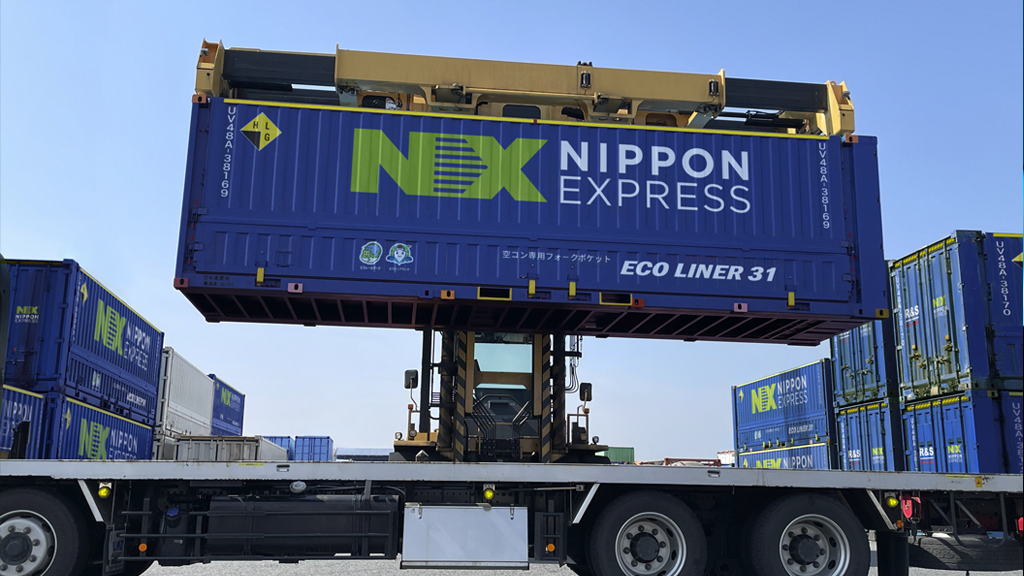
For export cargo from factories in the Kashima coastal industrial area to Tokyo Bay, the entire route was previously transported by maritime container drayage using trailers. However, the section from Kamisu Station (Kashima) to Tokyo Freight Terminal Station has been switched to rail transport. By loading ISO standard international maritime containers (20ft/40ft) directly onto the rail, a system has been established that allows for the efficient transport of large volumes of cargo in a short time without transshipment. -
Case Study 2: Cross-docking operations (Tokyo Bay → Nagano, import)
For imported cargo between Tokyo Bay and Nagano (250km one way), previously, the entire distance was covered by drayage of sea containers by trailer. However, a "cross-docking operation" has been introduced, where after customs clearance at Tokyo Port CY, the contents of the sea containers are transferred to 5-ton rail containers at Tokyo Freight Terminal Station. A scheme has been designed to complete the delivery to the Nagano area in two days, via Kita-Nagano Station.
Benefits
In direct transport (Case Study 1), the lead time for export cargo was shortened and costs were reduced simultaneously, while also ensuring punctual transport and avoiding the risk of cargo damage by eliminating transshipment. In cross-docking operations (Case Study 2), the inefficiencies in freight rates that occurred with 20ft container drayage were eliminated while maintaining lead times and punctuality that were not significantly different from conventional trailer transport.
Both methods contribute to reducing pollution and alleviating road congestion, while simultaneously addressing the problem of truck driver shortages (compliance with the revised Labor Standards Act).