Commercial practices and terminology can vary slightly from country to country or region to region, which can lead to problems.
Therefore, Incoterms were established to standardize the terms of trade and to avoid confusion, uncertainty, disputes, and lawsuits arising from differences in the interpretation of sales contracts.
The current Incoterms 2020(R) also consists of 11 conditions,
The DAT term in Incoterms 2010(R) has been eliminated, and DPU has been newly established in its place.
Incoterms 2020(R) are not legally binding, and these regulations are merely standardized guidelines.
If there are parts that do not conform to the actual transaction or transportation practices of the trading parties, they should be revised or worded in addition to the terms when the sales contract is made.
Incoterms is a registered trademark of the ICC. In the 2020 edition, it is displayed as "Incoterms(R)2020" or "Incoterms(R) 2020".
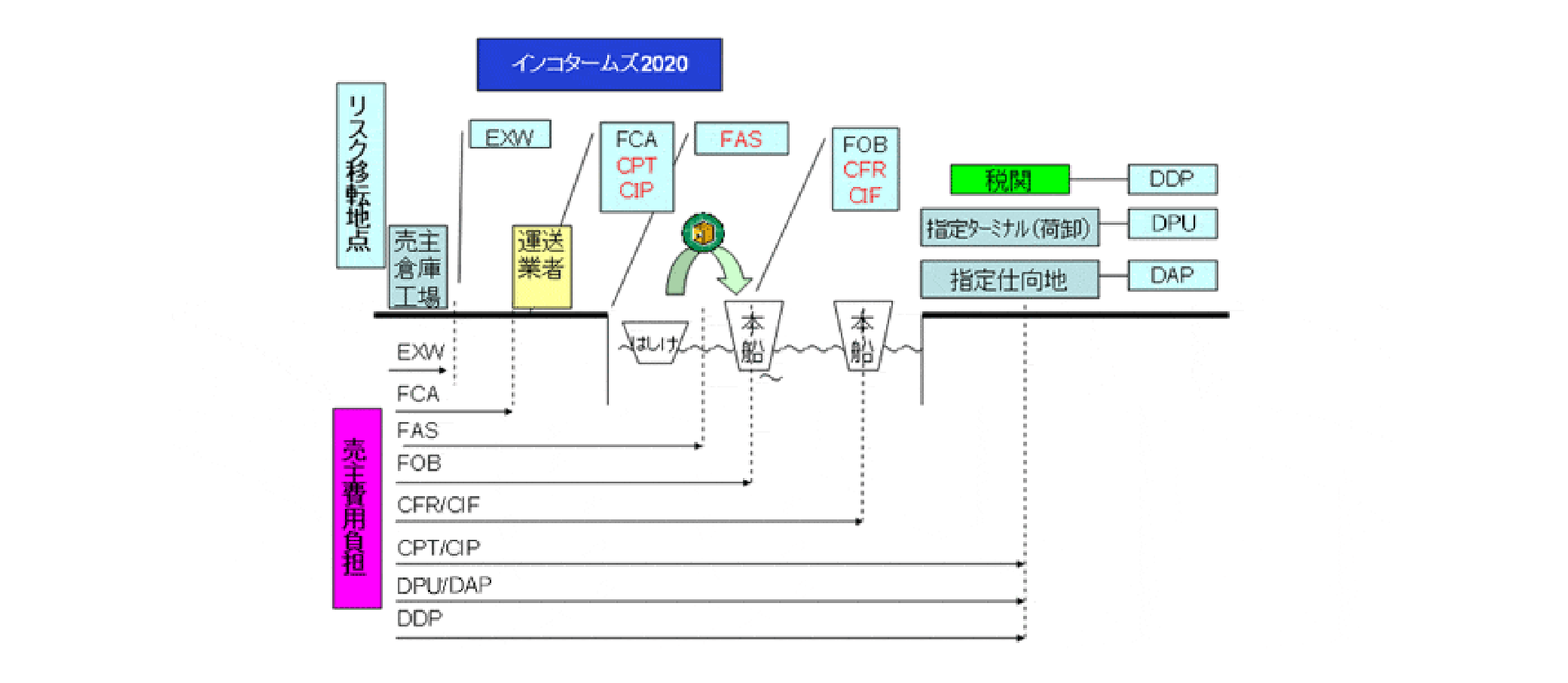
| Rules suitable for any means of transport | EXW | Ex-factory (insert designated delivery location) |
|---|---|---|
| FCA | Hand over to carrier (insert designated delivery location) | |
| CPT | Shipping costs included (insert specified destination) | |
| CIP | Shipping and insurance costs included (insert specified destination) | |
| DAP | Delivered to destination (insert specified destination) | |
| DPU | Delivered to destination (insert specified destination) | |
| DDP | Delivery including customs duties (insert specified destination) | |
| Regulations for maritime and inland transport | FAS | Side delivery (insert designated loading port) |
| FOB | Delivery by vessel (insert designated loading port) | |
| CFR | Includes freight (insert designated destination port) | |
| CIF | Freight and insurance included (insert designated destination port) |