3PL

3PL

"Third (3rd) Party Logistics (3PL for short)" generally refers to a company that proposes logistics reforms to shippers.
This refers to undertaking and carrying out comprehensive logistics operations.

Basically, 3PL (Third-Party Logistics) is considered a business in which a third party with expertise (sometimes the same as the carrier in Japan) plans, designs, and operates logistics from the shipper's perspective in order to resolve the inconveniences arising from the "conflict of interest" relationship between shippers and carriers.

Definition of a third party

In logistics, the main players are classified into "first parties" such as manufacturers and shippers, "second parties" such as wholesalers and retailers, and "third parties" such as logistics providers and 3PL companies. Furthermore, there are two types of operational models: "asset-type" companies that own their own logistics assets (warehouses, vehicles, etc.) and "non-asset-type" companies that do not own assets and specialize in planning and operation.
Asset-based third parties are categorized as logistics providers, while non-asset-based third parties are categorized as 3PL providers. The basic structure of the 3PL business is to support shippers' logistics reforms by combining the roles and strengths of both types of providers.

 Asset-basedNon-asset type
First PartyManufacturershipper
Second PartyWholesalers and retailersWholesalers and retailers
Third-partylogistics operator3PL providers

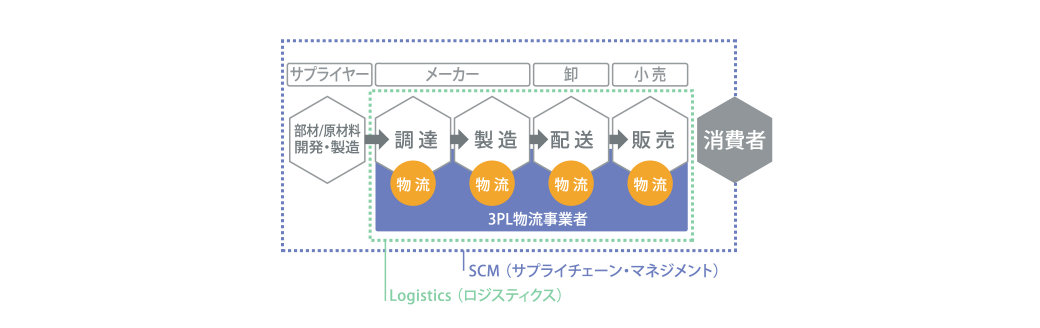
Conceptual diagram of 3PL business

In our "3PL" business, we comprehensively handle procurement logistics, in-factory logistics, sales logistics (inventory management and transportation management), and reverse logistics (industrial waste, returns, and repaired goods) on behalf of our customers' logistics sections.

Conceptual diagram of 3PL business

Elements that constitute a 3PL business

The 3PL business requires two capabilities: "logistics operation capabilities" and "logistics system design and proposal capabilities." Furthermore, three essential elements are "hardware," "software," and "humanware."
The NX Group possesses all three essential elements for developing a 3PL business, all at a high level.

Two required abilities

  • Logistics operation capabilities

    Logistics operation capabilities

    The ability to reliably and efficiently execute on-site logistics operations, including warehouse management, transportation, and inventory management. Stable operational quality and the ability to respond effectively to problems are essential.
  • Logistics system design and proposal capabilities

    Logistics system design and proposal capabilities

    The ability to oversee the client's business challenges and the entire supply chain, and to plan and design the optimal logistics system. Proposals must take into account multiple evaluation criteria, including cost, quality, lead time, and environmental impact.

3 elements

  • Hardware

    Hardware

    Warehouses, distribution centers, transport vehicles, material handling equipment, and other physical infrastructure that supports logistics operations.
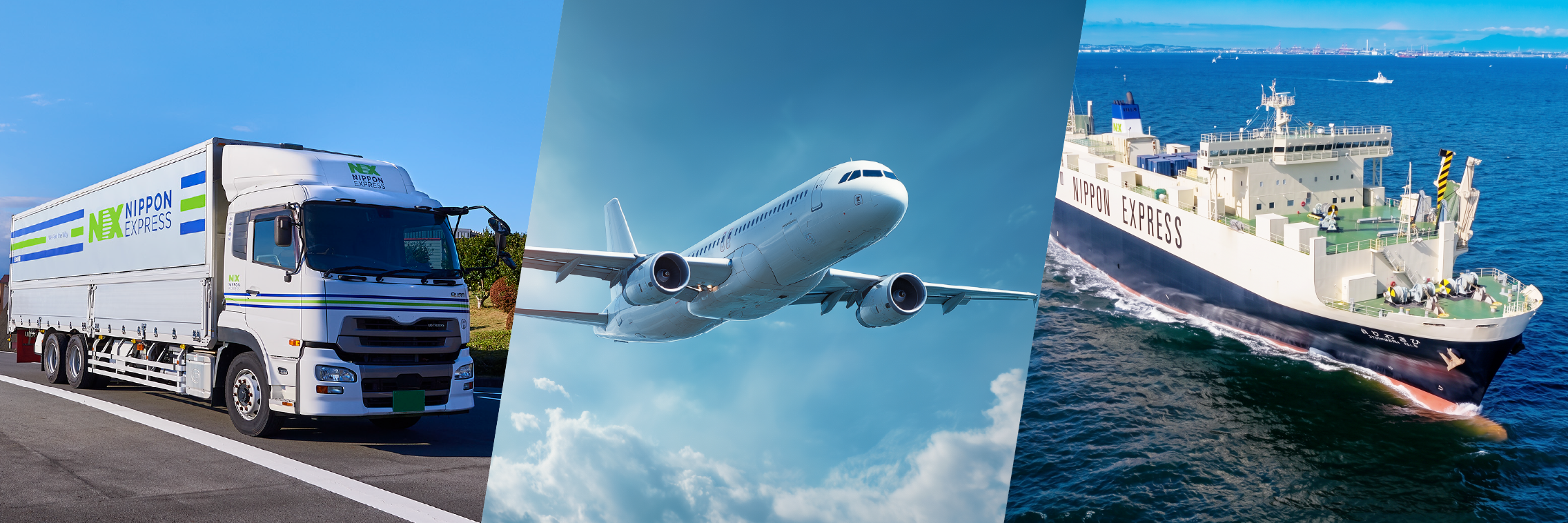
    The NX Group possesses six transportation modes encompassing domestic and international transport by land, sea, and air, as well as a wealth of warehouse locations spread throughout Japan and overseas, providing an execution platform as an asset-based third party.
  • Humanware

    Software

    Systems for operating logistics and handling information, such as WMS (Warehouse Management System), TMS (Transportation Management System), and visualization/analysis platforms.
    In addition to WMS and TMS, the NX Group has developed a proprietary platform that systematizes its logistics know-how accumulated over many years, as well as a suite of tools that support information sharing and efficiency at the operational level.
  • Software

    Humanware

    Our human resources—including field operators, planning and design staff, and IT engineers—along with their expertise and organizational knowledge, are the driving force behind our ability to effectively utilize hardware and software and drive continuous improvement.
    The NX Group brings together over 30 dedicated sales staff across various industries, specialized sales teams for each mode of transport, and the NX Research Institute, which functions as a think tank. Through collaboration among experts in industry, transport modes, and cost analysis, we provide optimal solutions tailored to the business challenges of our clients.