Emergency Shipping Support for Semiconductor Service Parts
Establishing a warehouse network in major semiconductor clusters to enable rapid supply response in emergency situations.
Customer:Semiconductor manufacturing equipment manufacturers
Challenge (Before)
In semiconductor manufacturing lines, unexpected equipment failures or malfunctions require the rapid supply of replacement parts. However, maintaining an in-house parts supply system designed for emergency response places a significant operational burden on equipment manufacturers. Establishing a framework that ensures both stable inventory management and immediate responsiveness was a key challenge.In addition, there was a growing need to establish an order reception system capable of handling requests during nighttime hours and on holidays.
Solutions
NX Solution
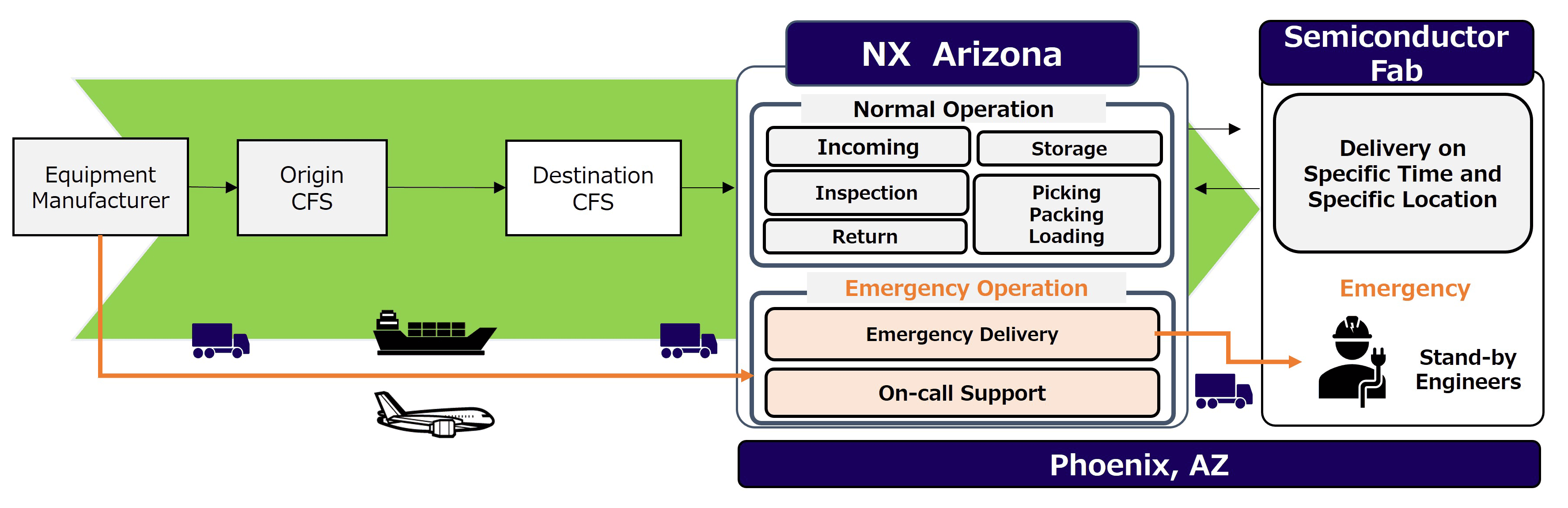
Established a storage and supply framework for service parts that can respond to emergencies in regions with a high concentration of semiconductor-related industries.
- Deployed on-site staff at parts supply hubs on a 24-hour weekday basis, with on-call support during weekends. During nights and holidays, requests from field engineers are accepted directly, and the entire process—from order handling to shipment—is managed in an integrated manner. Delivery rules are also defined based on urgency, including direct handover from drivers to engineers when required.
- Maintained product quality for precision equipment and semiconductor-related components by operating warehouses equipped with temperature and humidity control systems.
Benefits
Benefits (Results)
By centrally storing and managing semiconductor service parts at NX Group logistics facilities, rapid shipment response has become possible even in emergency situations. This operational framework has contributed to minimizing manufacturing line downtime, a critical requirement for semiconductor production facilities.
Furthermore, with 24/7 shipping support in place, semiconductor manufacturers no longer need to store service parts within their factories. This has enabled them to make more effective use of limited factory space for production line expansion and the installation of additional equipment.