Enhancing Distribution Efficiency and Reducing CO₂ Emissions through Collaborative Distribution
Improving delivery efficiency and restructuring logistics cost models to achieve both environmental impact reduction and cost optimization.
Customer:Food Manufacturer
Challenge (Before)
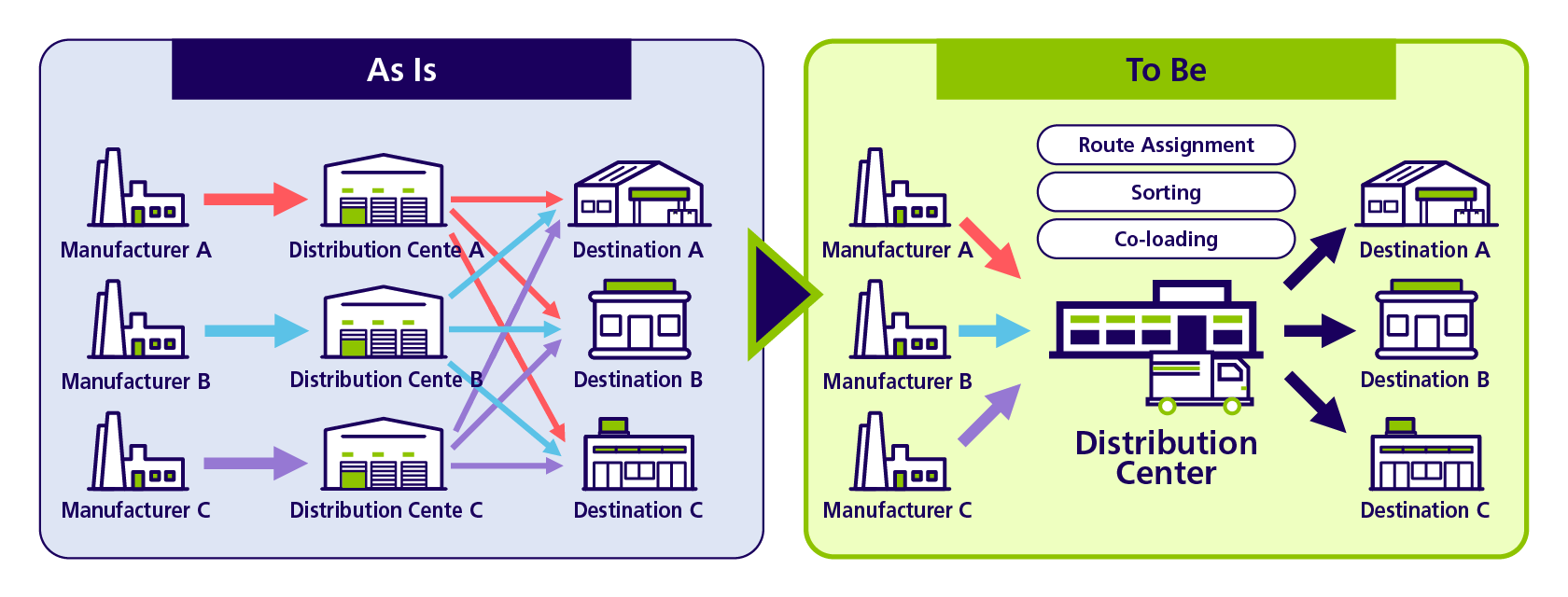
In store delivery operations for food and beverage products, multiple food manufacturers individually managed their own logistics operations to deliver products to numerous destinations such as retail stores, supermarkets, and convenience stores across Japan.
Despite significant fluctuations in shipment volumes by destination, deliveries were mainly conducted under a per-truck (“truckload-based”) freight structure, meaning transportation costs remained unchanged even on days with low shipment volumes. As a result, logistics expenses tended to become fixed costs.
In addition, trucks from multiple manufacturers often traveled to the same delivery destinations with low load factors. This increased the number of receiving operations required at the stores, placing additional burdens on store staff while also increasing CO₂ emissions due to the unnecessary number of vehicles in operation.
Solutions
NX Solution
- NX integrated store delivery operations previously handled independently by each manufacturer and designed a cross-manufacturer collaborative distribution scheme. A joint distribution center was established to consolidate products shipped from each manufacturer’s logistics facilities.
- Products were sorted by delivery region and shipping conditions, and goods from multiple manufacturers were combined into a single vehicle, improving load factors and reducing the total number of vehicles required.
- By delivering products from multiple manufacturers together, the number of receiving operations at delivery destinations was reduced. NX also handled optional services such as key management for deliveries to unmanned stores outside business hours.
- Flexible freight structures were introduced, including volume-based pricing and value-based pricing linked to product value, enabling logistics costs to be managed as variable expenses aligned with actual shipment volumes.
Benefits
Benefits (Results)
Through the establishment of a collaborative distribution framework among multiple manufacturers, the number of delivery vehicles was reduced compared with individual delivery operations, resulting in lower CO₂ emissions.
Logistics cost management was also improved. By shifting to volume-based and value-based pricing models, costs could be managed more precisely as variable expenses aligned with actual shipment volumes, eliminating unnecessary cost burdens during periods of low shipment volume.
Furthermore, the reduction in receiving operations at delivery destinations helped alleviate workloads for store staff and prevent lost sales opportunities, contributing to more efficient retail operations.