
Japan's Cargo Outlook, Upgraded: Air Pulls Ahead as Two Canals Squeeze Ocean Supply
Japan's trade year closed stronger than forecast, and NX Logistics Research Institute and Consulting (NXLRIC) has raised its FY2026 export outlook for both sea and air. Behind the upgrade sits an unusual alignment: disruption at the Suez and Panama canals at the same time — conditions that historically push cargo from ships to aircraft.
NX Logistics Research Institute and Consulting | Economic & Cargo Transport Outlook series | Analysis as of late July 2026
ABOUT THIS ANALYSIS
On July 14, 2026, NX Logistics Research Institute and Consulting (NXLRIC) published the second revision of its quarterly Economic & Cargo Transport Outlook, updating the FY2026 projections and confirming FY2025 results. All figures cover Japan-origin and Japan-bound trade on a fiscal-year basis (April–March); growth rates are year-on-year. A policy postscript at the end of this article reflects U.S. trade-policy developments as of early August. This follows our previous Insight on the April revision.
Three months ago, the question hanging over Japan's trade outlook was whether ocean exports could avoid another down year. The answer has come back more decisively than expected. FY2025 closed above forecast on nearly every line — and the January–March quarter, which NXLRIC had pencilled in as negative for ocean exports, instead beat projections by almost five percentage points on both modes. U.S. tariffs dragged less than feared, the yen stayed weaker for longer, and volumes rebounded against a soft prior-year quarter.
▲ 2.9% FY2025 air export growth, | ▲ 5.3% FY2026 air export growth | ▲ 0.1% FY2026 ocean export growth | 105.3 FY2026 air exports vs. 2019 |
NXLRIC forecasts published July 14, 2026. FY2025 ocean figures are preliminary pending final March port statistics.
Ocean exports flip positive;
air exports get a major upgrade
For FY2026, the pattern of the July revision is clean: exports up, imports trimmed. Ocean exports move from a forecast decline of 0.6% to slight growth of 0.1% — ending the run of negative full-year projections — while air exports jump from +2.6% to +5.3%, a 2.7-point upgrade that is large by the standards of this series. Two judgments drive the export upgrades: the correction of the weak yen is now expected even later, extending its boost to exports, and demand for AI-related semiconductors and Asia-bound goods keeps outperforming.
Imports were nudged down on both modes, though by less than a point: the same delayed yen correction that helps exports postpones the appreciation-driven lift to imports. Even so, import growth is projected to outpace exports through the year, accelerating in the second half as the yen begins to normalize.
FY2026 forecast revision — latest (July 2026) vs. previous (April 2026)
| Ocean export | Ocean import | Air export | Air import | |
|---|---|---|---|---|
| Latest (Jul 2026) | +0.1% | +2.7% | +5.3% | +5.5% |
| Previous (Apr 2026) | −0.6% | +3.1% | +2.6% | +6.3% |
| Revision | +0.7pt | −0.4pt | +2.7pt | −0.8pt |
Green highlight: forecast changed from decline to growth. Source: NX Logistics Research Institute and Consulting, Economic & Cargo Transport Outlook (Revised), July 14, 2026, vs. April 8, 2026 edition.
Air clears its 2019 bar on both sides — ocean exports enter year seven below it
Measured against pre-pandemic FY2019 levels, air freight is now decisively through. Air exports finish FY2026 more than 5% above the 2019 baseline, a second consecutive year above it, and air imports recover their 2019 level for the first time in five years — since the pandemic-era air-shift surge of FY2021. Ocean imports extend their run above the baseline to a second year, reaching 103.4.
Ocean exports remain the outlier: still more than 3% below 2019 even after the upgrade, with no recovery in any of the seven years since. Container volumes stay in the 4.7-million-TEU range — positive, but treading water.
Japan's international cargo vs. pre-pandemic levels
Index, FY2019 = 100. FY2026 is a forecast; FY2025 ocean figures are preliminary.
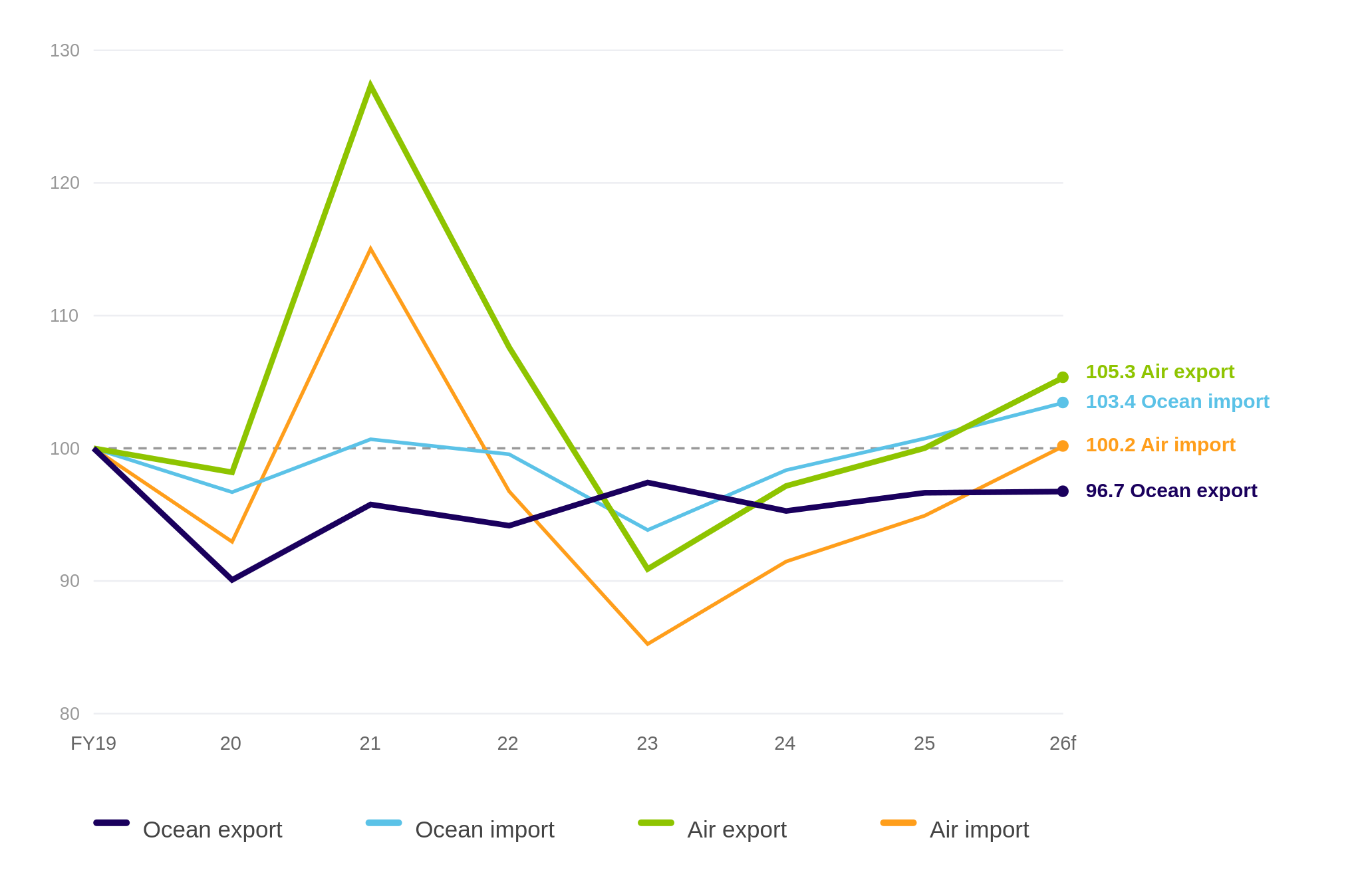
Source: NX Logistics Research Institute and Consulting, from port-authority statistics (eight major ports, laden TEU) and customs data (four major airports, tonnage).
A crash, a rebound, and a quiet rotation away from China
The month-by-month data behind the forecast tells three short stories. The most dramatic is the Middle East air lane: after the escalation in late February, Japan's air exports to the region collapsed by nearly 60% year-on-year in March — then turned positive in April, rose more than 60% in May, and more than doubled in June. The shock, in cargo terms, has already washed through. And because the lane accounts for less than 1% of Japan's air exports, its swings barely move the total.
The structural story is Asia. Exports to China have deteriorated since April, with double-digit declines in May and June — yet Asia-bound flows overall have stayed positive, as ASEAN, Taiwan, and India more than offset the roughly 30% of Asia-bound volume that China represents. U.S.-bound exports, meanwhile, have held steadily positive since April, one full year after the reciprocal-tariff announcement: the tariff drag, at least in volume terms, has largely run its course.
Suez and Panama are constrained at the same time — and air freight is the release valve
What makes this outlook unusual is that both of the world's great shipping shortcuts are constrained simultaneously — each for a different reason, and each feeding the same result: demand shifting from ocean to air.
ASIA–EUROPE · SUEZ
The delayed return
The U.S. and Iran signed an interim cease-fire memorandum in June — but strikes and the de facto blockade of the Strait of Hormuz have since resumed, clouding the path to resolution. A return to Red Sea and Suez transit is delayed again; Cape of Good Hope routings drag on, stretching voyage times and port congestion.
The silver lining for carriers: longer routings absorb the surplus vessels ordered during the pandemic. The consequence for shippers: conditions favoring an air shift on the Europe lane persist for now.
ASIA–NORTH AMERICA · PANAMA
El Niño returns
A developing El Niño is drying out the Panama Canal watershed. Draft restrictions were tightened over July–August, and transit-number limits may follow — a rerun of the 2023 drought, but from a stronger El Niño. If U.S. East Coast ocean volumes cannot be absorbed via West Coast ports and inland rail, air substitution demand rises on the transpacific too.
A further wildcard: the U.S.–China truce on reciprocal port-entry fees for each other's vessels expires in November 2026, risking fresh scheduling disruption.
Resilience buying — and a flood of low-priced goods with nowhere else to go
Japan's import strength has a defensive logic. With China tightening export controls on dual-use goods bound for Japan — rare earths potentially in scope — government and industry are accelerating supplier diversification, stockpiling, and safety-stock programs. If disruption fears trigger over-ordering, producer-goods imports keep climbing.
A second, less deliberate force is also at work. As China's economy slows, its overcapacity keeps flowing outward as low-priced exports — but the U.S. and Europe have spent two years building walls against them, from EV and solar tariffs to the abolition of de-minimis duty exemptions for small e-commerce parcels. Japan has fewer such barriers. NXLRIC expects the resulting inflow of low-priced Chinese goods — including via third countries — to outweigh the loss of restricted items like rare earths, adding a further push to import volumes.
The base case — and the double-digit air scenario
NXLRIC's central scenario has the Middle East and Iran situation settling from the July–September quarter, with Red Sea and Suez transit normalizing gradually from October–December into early 2027 — slightly later than assumed in April.
| Jul–Sep 2026 | Base case: Middle East and Iran tensions begin to settle; Panama draft restrictions bite over the summer. |
|---|---|
| Oct–Dec 2026 | Red Sea and Suez transit begins normalizing; U.S.–China port-fee truce expires in November; next revision published early October. |
| Jan–Mar 2027 | Shipping disruption and port congestion ease through the slack season; the air-shift premium fades. |
The downside — and the upside:
if the Middle East crisis persists past the fourth quarter, prolonged shipping disruption could tip ocean exports back into decline — while sustained ocean-to-air diversion could push air export growth into double digits. A separate risk sits in the export-control channel: the impact of China's restrictions is limited so far, but if alternative sourcing stalls and factory curtailments spread among Japanese exporters, exports would take the hit.
The next revision — the third and final of 2026 — is due in early October, incorporating the latest on the Middle East, U.S. tariff and maritime policy toward China, and the extent of any air-shift demand.
POLICY POSTSCRIPT Added August 5, 2026
U.S. tariffs: a new Section 301 regime, and somewhat less fog
The stop-gap flat tariff under Section 122 — introduced after the reciprocal and fentanyl tariffs were struck down — expired on July 24. In its place, the U.S. Trade Representative invoked Section 301, citing inadequate responses to forced labor, imposing additional tariffs on some 60 countries and territories at 10.0% or 12.5%. Japan's rate is in principle 12.5%, with an adjustment mechanism ensuring no product faces more than 12.5% in add-ons; goods already tariffed at that level or above see no increase, and existing sectoral tariffs — such as the 15% on Japanese autos — sit outside the new regime. The headline rate rises from 10.0% to 12.5%, but with the legal uncertainty of the past year partly cleared, NXLRIC sees scope for the drag on U.S.-bound exports to fade.
USMCA: no extension — the clock starts ticking
The joint review of the U.S.–Mexico–Canada trade agreement closed in July without agreement to extend. The pact now faces annual negotiations; failing agreement, it expires in 2036 (a July deal would have extended it to 2042). Washington — which had demanded at least 50% U.S. parts content for tariff-free autos — remains reluctant, talks with Canada stalled, and withdrawal remains a live possibility, with direct implications for Japanese manufacturers' North American supply chains.
WHY IT MATTERS FOR GLOBAL SUPPLY CHAINS
The July revision captures a market in rotation: tariffs receding as the dominant variable, and physical chokepoints — Suez, Hormuz, Panama — taking their place. When both canals tighten at once, air freight stops being a contingency and becomes the plan, and space on Europe- and U.S.-bound lanes tightens accordingly.
For shippers, the practical agenda follows directly: secure air capacity early on Europe and transpacific lanes rather than chasing it after disruption hits, revisit the West Coast–inland option before East Coast constraints bind, and treat sourcing diversification not as a one-off project but as a standing driver of inbound volume.
This article was originally written in Japanese by members of NX Logistics Research Institute and Consulting, Inc. (NXLRIC) as part of its Economic & Cargo Transport Outlook series. It has been revised, supplemented, and translated into English by Nippon Express Holdings, Inc. for an international readership. Analysis is as of July 24, 2026, with a policy postscript as of August 5, 2026; figures are subject to revision in subsequent editions.
© 2026 Nippon Express Holdings, Inc. / NX Logistics Research Institute and Consulting, Inc.